Data Gap or Data Mess
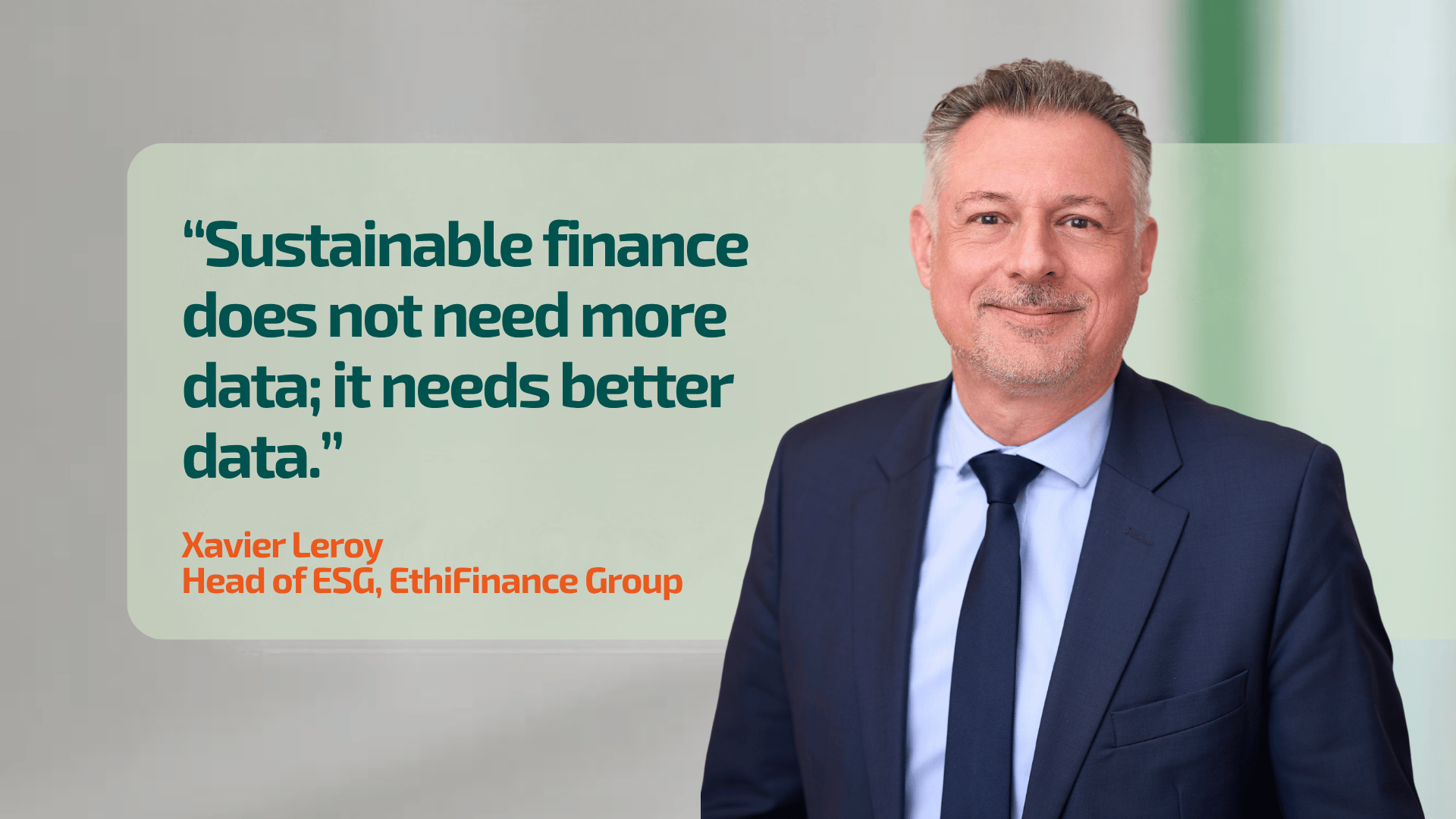
XavierLeroy, Head of ESG, EthiFinance Group – October 2026
Sustainablefinance is running up against a familiar obstacle: access to reliable,comparable and usable data. While traditional finance relies on regulated,standardised and audited information, ESG analysis and non-financial reportingstill too often depend on data that is incomplete, inconsistent or difficult toverify.
This “datagap” takes many forms: missing information, non-comparable data, reliance onuncertain proxies, or indicators available for some asset classes but absentfor others. The gaps are particularly acute in private markets, real assets,SMEs and emerging markets. They also affect complex areas such as biodiversity,human rights, Scope 3 emissions and the real-world impact of investments.
Breaking through this data barrier is essential. Without sufficiently robustinformation, sustainable finance risks misallocating capital. Better-qualitydata, by contrast, would enable it to fulfil its role in transforming theeconomy.
A Bottomless Pit?
The paradox is striking:For more than a decade, the ESG data provider landscape has expanded rapidly,bringing increasingly sophisticated, technology-driven and specialisedsolutions to the market. Yet the gap between the data required and the dataavailable continues to widen.
Thistension reflects the rapid expansion of sustainable finance. Once focusedprimarily on large listed companies, for which information is public andreadily accessible, it now spans a far broader universe. It has also embracednew approaches, from thematic strategies and just transition investing toimpact finance. As ambitions expand, data needs are becoming both greater andmore complex.
The verynature of non-financial information adds to the challenge. Measuring adecarbonisation pathway, assessing exposure to social controversies orevaluating the quality of governance is far less straightforward than recordingrevenue or a debt ratio. Despite progress in reporting standards, frameworksremain fragmented across jurisdictions, making the consolidation of globalportfolios a complex undertaking.
This is compounded by a less supportivepolitical environment. The backlash against sustainable finance—most visible inthe United States, but also perceptible in Europe as well—is weighing on theavailability of non-financial data. The European Omnibus Directive adopted in2025 illustrates this retreat: it significantly reduces both the number ofcompanies subject to non-financial reporting—to less than 80% of the scopeinitially envisaged—and the volume of data they are required to disclose.
The Institutional Investor’s Data Challenge
Forinstitutional investors, this has become a major operational challenge.Insurers, banks and pension funds manage global portfolios spanning multipleasset classes and jurisdictions. They need reliable, comparable data across allthese asset classes to steer their investments and meet their regulatoryobligations. The challenge is particularly acute in private equity and privatedebt, whose share of portfolios continues to grow.
To makematters worse, the asset managers to which institutional investors delegatetheir mandates often rely on different providers, generating fragmented,non-comparable information that is difficult to consolidate.
Theconsequences are highly tangible: difficulties complying with certaininvestment policies, reputational or legal risks, fund downgrades, and risingcosts associated with multi-sourcing, data cleansing and direct outreach toissuers. This is therefore not merely a technical issue: it goes to the veryheart of how sustainable finance is managed—and how much it costs to implement.
When More Data Isn’t Better Data
Theaccumulation of ever more specialised and granular data is not necessarily thesolution. It can create the illusion of better coverage while furtherfragmenting information and obscuring significant disparities in quality andrelevance.
Sustainablefinance does not need more data; it needs better data. That requires threepriorities.
Focus, first: prioritising a more limitedset of indicators that are genuinely available, verifiable and usable acrossentire portfolios.
Materiality, next: distinguishing theinformation that truly matters according to sector, asset class and investmentobjective.
Integration, finally: connecting differenttypes of data to build a coherent view across global portfolios.
After a decade of rapid expansion, sustainablefinance is entering a new phase of maturity. Its next leap forward will notcome from an inflation of indicators, but from data that is better selected,verified, standardised and comparable.
Biography of the author:
Xavier Leroy, Head of ESG at EThiFinance
Based in ParisXavier brings more than 30 years of experience in financial markets and leads the development of the Group's ESG offering.
More news
Explore related insights and analysis