EthiFinance, BME and Cesce highlight the need to diversify funding sources

EthiFinance, BME and Cesce highlight the importance of diversifying funding sources and assessing risks in the current geopolitical environment to strengthen business competitiveness
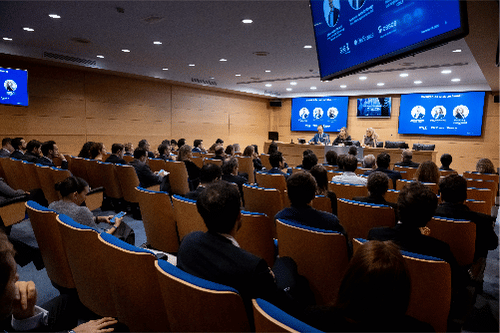
Madrid, 19 November 2026. EthiFinance, an independent European group specialising in Credit Ratings and ESG Ratings, Bolsas y Mercados Españoles (BME) and Cesce have held the second edition of the event “The State of Financing in the Current Geopolitical Context” at the Palacio de la Bolsa in Madrid. The event, which drew more than 120 registered attendees, addressed how geopolitical uncertainty, economic risks, sustainability challenges and the drive for European strategic autonomy may shape the financing needs and investment decisions of Spanish companies.
Why does diversifying funding sources matter in the current geopolitical context?
The collaboration between EthiFinance and Cesce is part of an agreement signed by both organisations in February 2025 to facilitate Spanish companies’ access to financing and risk coverage solutions. The agreement provides for the incorporation of EthiFinance’s Credit Ratings into Cesce’s corporate risk assessments for applications for coverage on behalf of the Spanish State, as well as the development of joint initiatives to strengthen business competitiveness.
In this scenario, diversifying funding sources is key to strengthening business competitiveness and resilience. The complementary role of public financing instruments, bank lending and capital markets widens the range of available alternatives, especially for projects linked to sustainability and European strategic autonomy. For their part, Credit Ratings help to independently assess the financial profile of issuers, providing transparency and confidence to investors.
The opening session featured Adolfo Estévez, Managing Director of EthiFinance and Chairman of the European Association of Credit Rating Agencies (EACRA); Susana de Antonio, Head of Primary Markets at BME; and Patricia Polo, Head of Strategic Business Relations at Cesce.
In his remarks, Adolfo Estévez stressed the importance of diversifying funding sources in a more demanding economic environment:
“Markets remain open to issuers, but they are more selective and demand a higher risk premium. In this context, diversifying funding sources is not just a competitive advantage, but a way to build stronger, more resilient companies”
How is geopolitics affecting the Spanish economy and access to financing?
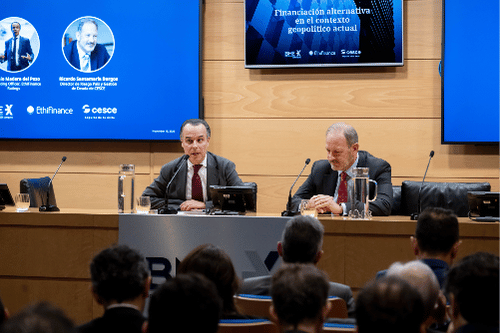
The impact of the geopolitical context on the economic and financial outlook was the focus of the conversation between Antonio Madera del Pozo, Chief Rating Officer at EthiFinance, and Ricardo Santamaría, Head of Country Risk and Debt Management at Cesce. Both discussed how international risks can affect business activity, credit profiles and conditions for accessing financing.
In this regard, Antonio Madera highlighted the resilience of the Spanish economy despite international tensions:
“The Spanish economy is holding up in a complex geopolitical environment. Our leading indicators point to growth of 0.7% in the fourth quarter, which would allow 2026 to close with growth of around 2.6%”
What alternatives exist to bank financing for mid-sized companies?
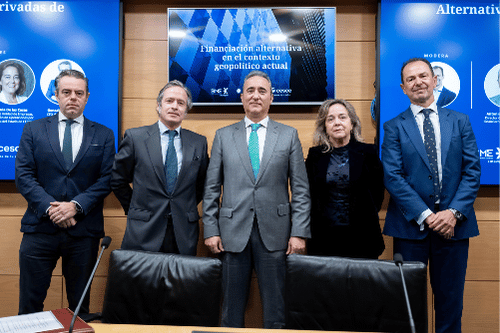
The search for financing alternatives to meet corporate investment needs was the focus of another panel, moderated by Adolfo Estévez and featuring representatives of the Instituto de Crédito Oficial (ICO), Banca March, Cesce and Grupo Amper. During the discussion, ICO highlighted its goal of deploying around €60 billion through its own financing activities over the next five to seven years, with the capacity to mobilise up to €120 billion through collaboration with the private sector.
Likewise, private-sector representatives underscored the role of capital markets as a source of financing for mid-sized companies and the importance of independent credit ratings in facilitating access to these instruments. In this context, they highlighted EthiFinance’s contribution to the development of the fixed-income market for mid-sized companies.
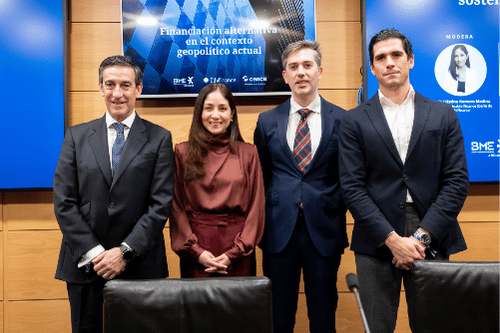
How do sustainability and strategic autonomy shape financing needs?
Financing needs also extend to projects linked to sustainability and European strategic autonomy, especially in industrial sectors that require significant investment. Representatives of TSK, Lantania and Santander Corporate & Investment Banking discussed the relationship between sustainability, business resilience and financing, in a debate moderated by María Cristina Romero, Head of Sustainable Finance at EthiFinance.
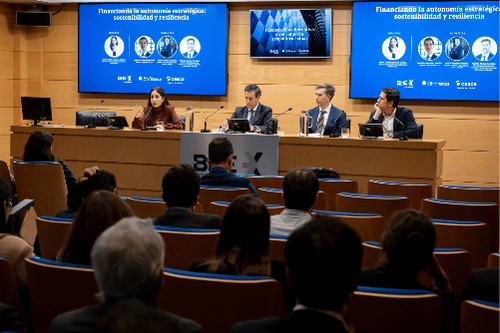
What role can fixed-income markets play for mid-sized companies?
Finally, a dedicated session focused on fixed-income markets as an alternative source of corporate financing. Cristina Pamplona, Head of Fixed-Income Primary Markets and Issuers at BME, and Yurena Martínez de Murguía, Head of Origination in Primary Markets, analysed the evolution of these markets and the opportunities offered by instruments such as bonds and commercial paper. In this regard, the role of MARF in facilitating mid-sized companies’ access to capital markets and broadening their financing options was highlighted.
What did the speakers agree on?
Speakers agreed on the importance of facilitating companies’ access to different sources of financing in order to cope with geopolitical uncertainty and undertake new investments. Public-private collaboration, the assessment of credit and sustainability risks, and the development of capital markets stand out as key factors for strengthening industrial competitiveness and moving towards greater European strategic autonomy.


About BME
BME operates the Spanish stock exchange and financial markets and has been part of the SIX group since 2020. It holds a leading position and is a strategic partner for corporate financing.
About Cesce
Cesce, the Spanish Export Credit Insurance Company, is the parent of a group of companies offering comprehensive solutions for commercial risk management and the provision of surety insurance and guarantees in Europe and Latin America. It also acts as the Export Credit Agency (ECA) on behalf of the Spanish State, managing export credit insurance.
About EthiFinance
Founded in Paris in 2004, EthiFinance is an independent European group specialising in credit ratings, sustainability ratings and extra-financial analysis solutions. Deeply committed to advancing sustainable finance, the Group supports financial and economic stakeholders in making informed decisions in response to major environmental, social and governance (ESG) challenges.
Through its various activities, EthiFinance serves more than 500 investors, banks, insurance companies and corporates, providing high value-added analysis, ratings and decision-support tools. Its dual materiality approach enables clients to assess both financial risks and the environmental and social impacts of their activities.
The Group’s offering covers the entire ESG and credit risk analysis value chain, including data provision, ratings, expert opinions, independent research and the development of forward-looking models. Through its international expansion, EthiFinance now provides global coverage.
Following several growth and integration initiatives, the Group today brings together more than 250 employees, primarily based across Europe and India.
EthiFinance’s credit rating activities are regulated by the European Securities and Markets Authority (ESMA). The Group is also an active member of the European Association of Credit Rating Agencies (EACRA) and the European Association of Sustainability Rating Agencies (EASRA).
International presence
Paris • Lyon • Madrid • Granada • London • Frankfurt • Hanover • New Delhi
Press contacts
EthiFinance - Thinking Heads
Josefina Trecco – jt@thinkingheads.com - Tel. 678 68 24 93
Rafael Sánchez – rsm@thinkingheads.com - Tel. 673 893 472
Cesce
Ángeles Sancho - angeles.sancho@cesce.es
Bolsas y Mercados Españoles (BME)
Alberto Roa – alberto.roa@grupobme.es - Tel. 649 855 712
More press releases
Explore related insights and analysis