Macroeconomic Outlook November 2026


Executive Summary
The geopolitical environment remains binary and highly volatile. The main upside risk to inflation and interest rates would stem from an escalation in the Gulf, while the downside surprise would come from a scenario in which diplomatic efforts in Ukraine succeed alongside a de-escalation in the Strait of Hormuz. Until these tensions are resolved, risks to energy prices and, by extension, sovereign borrowing costs remain tilted to the upside.
In the US midterm elections, the Democratic Party secured a majority in Congress, setting the stage for a clearly divided government over the remaining two years of President Trump’s term. Nevertheless, we expect the presidential veto and the absence of a supermajority in the Senate to keep fiscal policy broadly stable.
The energy supply shock persists. Brent crude, which remains highly volatile and sensitive to geopolitical developments, closed the month at USD 113.4 per barrel (USD 94 at the time of writing), 13.6% above its September closing level. The Strait of Hormuz remains effectively blocked, while a further incident involving an oil tanker struck by a limpet mine highlights the fragility of energy supplies.
Central banks ended October with policy rates unchanged, albeit maintaining a distinctly hawkish stance. Markets are therefore pricing in another rate increase by the European Central Bank at its December meeting. The main surprise has come on the institutional front, following the announcement that Christine Lagarde will step down in February 2027, accelerating the race to succeed her. Nevertheless, we do not expect this development to alter the ECB’s anticipated monetary policy trajectory.
In sovereign debt markets, higher real interest rates are exerting upward pressure on yields of traditionally perceived risk-free assets, although significant divergences persist within the EU core. The French 10-year government bond yield closed at 4.97%, virtually in line with its US Treasury counterpart, with a spread of 163 basis points over the German Bund, now twice the Spanish spread.
On the macroeconomic front, third-quarter GDP figures continue to point to a two-speed European economy. Spain, on the one hand, performed in line with expectations, recording quarter-on-quarter growth of 0.6%. At the other end of the spectrum, France contracted by 0.1% quarter-on-quarter. We maintain our year-end forecasts.
What are the main geopolitical risks for the economy?
October’s geopolitical risk map continues to feature six active flashpoints, with particular emphasis on the eastern front in the Strait of Hormuz and the north-eastern front in Ukraine, given their potential to transmit instability across the wider international economic system.
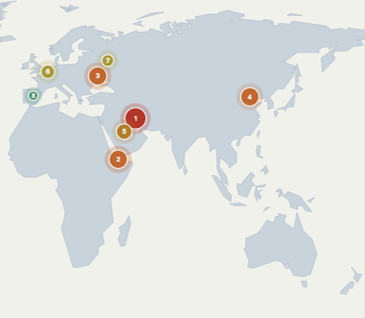
The war in Iran has now entered its eighth month, with transit through the Strait of Hormuz still far from normalized, despite indirect negotiations, primarily mediated by Qatar and Pakistan, remaining at least partially open. The immediate question is whether, with the US midterm elections now over, the White House will opt for a renewed offensive alongside Israel. In Israel, legislative elections held just a few days ago have highlighted Netanyahu’s gradual loss of political leadership, with an inconclusive result threatening to usher in a period of instability reminiscent of 2019 to 2022. Although this situation could, in principle, favor a path towards ending the war, we should not overlook the broad bipartisan convergence between the United States and Israel on security and foreign policy. We therefore do not expect a change of government to materially alter the course of the conflict. Moreover, the energy risk premium remains sensitive to tensions between Saudi Arabia and the Houthis.
Turning to the war in Ukraine, now approaching its fifth year, the probability of a ceasefire is increasing, although it remains remote given the continued exchange of attacks on energy infrastructure and refineries. These developments continue to threaten European gas supplies, refining capacity and grain production, all of which are particularly vulnerable ahead of the coming winter. On the battlefield, independent assessments of frontline developments suggest that the Russian advance has virtually stalled, while Ukraine has continued to regain territory in key eastern sectors. At the same time, Kyiv has intensified its long-range strikes against industrial, logistical and energy infrastructure inside Russia. According to Ukraine’s own estimates, Moscow suffered its highest monthly casualties since the beginning of the invasion. Against this backdrop, Brussels has proposed mobilizing the remaining EUR 45 billion of its financial support loan to Ukraine for 2027. Nevertheless, for the first time in months, a potential humanitarian truce has emerged in connection with plans for a trilateral meeting between Russia, Ukraine and the United States in a Gulf capital. Should such a truce materialize and prove sustainable, it would represent a significant downside surprise for Europe’s energy risk premium.
Meanwhile, October ended with an extension of the US-China trade truce until 10 January 2027, a positive development that should be viewed in the context of the diplomatic efforts demonstrated by both countries at the Washington summit in late September. Although the truce encompasses restrictions on rare-earth exports, the underlying strategic problem remains unresolved. China accounts for approximately 70% of the mining output of minerals considered strategic by Western economies, with Brazil ranking as the world’s second-largest producer. This dominant position provides Beijing with a powerful bargaining tool in an environment characterized by persistent tariff threats and restrictions on global trade flows.
Turning again to the United States, November began with an electoral event of considerable significance: the midterm elections. Consistent with the historical tendency for midterm elections to penalize the incumbent president’s party, the Democrats regained control of both the House of Representatives and the Senate. This outcome creates a challenging political environment for the second half of President Trump’s term, particularly regarding fiscal policy over the next two years. Nevertheless, the absence of a supermajority in the Senate and the president’s veto power should mitigate the scope for substantial changes in fiscal policy.
Finally, looking towards Europe, the final months of the year are traditionally dominated by the preparation and approval of national budgets across the European Union. This process, already challenging in several member states, is taking place against an economic backdrop characterized by weakened fiscal credibility and increasingly demanding financial markets, which are calling for greater discipline as public debt reaches record levels and debt-servicing costs continue to rise. These pressures reflect several factors, including monetary policy, investment in artificial intelligence and structural fiscal imbalances. Against this backdrop, France, Germany, Portugal and Spain, among others, ended October facing public demonstrations demanding the preservation of welfare systems that are becoming increasingly difficult to reconcile with medium- and long-term structural challenges exerting sustained upward pressure on public expenditure.
Adding to these challenges is the recent announcement of Christine Lagarde’s resignation, with her departure from the European Central Bank scheduled for February 2027. This development introduces uncertainty regarding the future direction of monetary policy under either of the two leading candidates to succeed her: Pablo Hernández de Cos, former Governor of the Bank of Spain and current General Manager of the Bank for International Settlements, and Klaas Knot, former President of De Nederlandsche Bank.
Looking ahead to November, we highlight two key risks that warrant close monitoring given their potential economic implications:
- A renewed offensive against Iran. The outcome of Israel’s elections has left a caretaker government without a clear parliamentary majority, but with incentives to keep the military option on the table. Beyond the risk of further military escalation, the persistence of damaged infrastructure following attacks on the country’s main oil pipeline, combined with regional diplomatic efforts that have yielded limited results, represents the key risk to monitor in November. A renewed escalation could push Brent crude towards the upper end of our projected range, with the resulting pass-through to inflation and interest rates.
- Political instability and financial market volatility. Political uncertainty is expected to remain elevated following the outcome of the US midterm elections, the announcement of early elections in Spain, where a shift towards a center-right government is expected, potentially requiring a coalition agreement, and the continuation of social mobilization in France. In the latter case, persistent political and social tensions could prevent the approval of the national budget.
Where are oil, gas and metal prices heading?
Oil and Gas. Oil has once again acted as a barometer of geopolitical risk, closing October at USD 113.4 per barrel, 13.6% above its September level. This marked the fourth consecutive month of gains, with an intraday peak of USD 116.7 recorded on 23 October. The increase does not reflect a recovery in demand, which is, in fact, weakening, but rather persistent supply constraints. These pressures are transmitted to the real economy through two main channels: (i) natural gas, whose rising cost directly affects electricity prices; and (ii) refined petroleum products, particularly diesel and heating oil, which indirectly increase the cost of intermediate goods and, consequently, inflation.
Looking towards the end of the year and the beginning of 2027, our baseline scenario places crude oil prices within a range of USD 110 to 117 per barrel in January. Only meaningful diplomatic progress concerning the Strait of Hormuz would bring prices back below USD 106. Energy therefore remains the principal upside risk to inflation and, by extension, to sovereign and corporate borrowing costs.
In its baseline scenario, the International Monetary Fund itself assumes that the energy shock will not dissipate while the Strait remains closed. Similarly, the consensus among major asset managers assigns a low probability to crude oil prices remaining sustainably above USD 120 per barrel, although it does not expect the inflationary effects of the shock to fade before the second half of 2027.
Metals. Gold declined by approximately 7% during October, recording its worst October performance since 2008 and closing at around USD 3,900 per ounce after reaching a one-year low. Silver, platinum and palladium also suffered double-digit declines, highlighting that gold is no longer behaving as a traditional hedge against inflation. This performance primarily reflects expectations of rising real interest rates rather than accelerating inflation. Meanwhile, copper fell below USD 6.50 per pound, weighed down by weakening demand. Nevertheless, the longer-term structural outlook remains bullish, supported by increasing investment in electricity grids to accommodate the expansion of artificial intelligence.
Agricultural Commodities. Grains and oilseeds recorded sharp declines, with maize and wheat falling by approximately 10% and soybeans experiencing somewhat smaller losses. These movements occurred despite persistent supply-side risks arising from disruptions at Black Sea ports and fertilizer shortages linked to the situation in the Strait of Hormuz.
What are central banks doing, and what does it mean for sovereign yields?
Following the synchronized interest rate increases in September, October was a month of monetary policy pauses.
European Central Bank (ECB). The ECB kept its deposit facility rate unchanged at 2.50% at its October meeting, although the Governing Council discussed a potential increase. Markets continue to price in another rate hike in December and possibly a further increase in the first quarter of 2027. The institutional development is equally significant: Christine Lagarde announced that she would step down as ECB President in February, triggering a succession process in which Klaas Knot and Pablo Hernández de Cos have emerged as leading candidates.
The Federal Reserve maintained its target range at 3.75-4.00% on 28 October, although the 10-2 vote signaled the growing influence of the hawkish wing of the Committee. Futures markets assign an approximately 85% probability to a rate increase at the 9 December meeting. Against this backdrop, robust US economic growth and the labor market remain central to monetary policy expectations, with the employment report due in early November likely to reinforce market expectations. The current pause should be viewed in its broader context: the year began with markets pricing in interest rate cuts but has since evolved into a synchronized monetary tightening cycle.
Rather than signaling the end of the cycle, we view October’s decisions as a temporary pause before further increases, with at least one additional hike expected from both the ECB and the Fed before the summer of 2027. Under our baseline scenario, the first rate cuts would not materialize until well into the second half of 2027, once the inflationary effects of higher energy prices and tariffs begin to subside.
Turning to sovereign risk premia, October ended with significant divergences across European sovereign debt markets. France continued to lead the ranking, with its 10-year government bond yield closing the month at 4.97%, broadly in line with US Treasury yields and well above the 3.5% recorded just a year earlier. The spread over the German Bund reached 163 basis points. Meanwhile, Spain’s sovereign risk premium ended October at 62.97 basis points and, despite widening by 32% during the month amid a global bond market sell-off, remained approximately 80 basis points below its French counterpart. Finally, Italy’s sovereign spread closed at around 90 basis points, benefiting from fiscal discipline that continues to be rewarded by financial markets.
Figure 1: Sovereign risk premiums. Source: Market data.

How is the European economy performing, and what do we forecast?
The latest macroeconomic data once again place Spain in the spotlight, as the economy continues to expand strongly while recording the highest inflation rate in the euro area. GDP grew by 0.6% quarter-on-quarter and 2.7% year-on-year in the third quarter, the latter one-tenth of a percentage point below the previous quarter, but still maintaining a positive growth differential over the eurozone. Meanwhile, October’s flash CPI estimate remained at 4.9%, with core inflation standing at 3.1%.
By contrast, France recorded a 0.1% GDP contraction in the third quarter, while its composite PMI returned to contractionary territory in October, making it the weakest-performing economy in the euro area. The French manufacturing PMI fell to 49.3, with new orders declining for five consecutive months amid subdued external demand. Harmonized inflation rose to 3.8% in October, driven by energy prices, while domestic political uncertainty further undermined business confidence and weighed on investment and consumption. Overall, France presents the clearest signs of stagflation among the major euro area economies, combining declining economic activity with rising prices.
Germany, meanwhile, recorded GDP growth of 0.2% in the third quarter, while its composite PMI accelerated further, signaling one of the strongest recoveries since early 2022. The manufacturing PMI reached 54.2 in October, the strongest reading among the euro area’s major economies. Inflation declined to 2.8%, from 3.3% in September, largely reflecting a temporary reduction in fuel taxes introduced on 1 October. Nevertheless, the recovery remains fragile: energy costs are still elevated, and the industrial rebound is taking place against a backdrop of persistently subdued domestic demand.
Meanwhile, the United States surprised on the upside, recording annualized GDP growth of 3.4% in the third quarter, driven by consumer spending and private investment. With the PCE price deflator standing at 2.1%, the Federal Reserve retains some room for maneuver, at least for the time being. China, by contrast, disappointed. Its official manufacturing PMI fell to 49.3, returning to contractionary territory and potentially prompting Beijing to step up its stimulus measures.
Looking towards the end of the year, our forecasts at EthiFinance Ratings point to a recovery in economic growth as we enter 2027. Against this backdrop, we expect Spain to continue leading economic growth, closely followed by Portugal. At the other end of the spectrum, France and Italy are expected to record growth rates well below their respective potential levels.
Figure 2: GDP Forecasts. International comparison.*

Figure 3: Inflation.*

Figure 4: Fiscal balance. *

Figure 5: Public Debt. *

*Source: EFR’s forecasts.
About the author
Antonio Madera Del Pozo
Chief Rating Officer, EthiFinance
PhD in Economics. Recipient of the José Ramón de San Pedro Award for the best doctoral thesis. Financial adviser accredited by the CNMV. Extensive experience in credit risk analysis (corporates, banking, LBOs, project finance and public sector risk), scoring models and risk.
More news
Explore related insights and analysis