European High Yield Market, October 2026

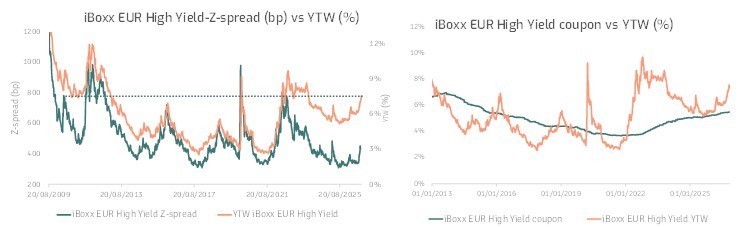
Spreads kept widening in October, and Spread Research does not expect any tightening by year-end 2026.
Credit risk resurfaces as market Conditions Deteriorate
With a potential AI correction, energy prices again on the rise and a new European sovereign debt crisis in mind with France, spreads continued to widen in October in the EUR High Yield market (+64bp to Z+470bp). Total return was negative at -1%, against -1.6% in September during the interest rate sell-off, leading to a negative YTD total return of -0.6%. With 3Q26 results showing a persistently tough economic environment and growing difficulties in addressing debt, we do not expect any tightening in spreads by year-end 2026, while issues regarding EUR sovereign debt will remain unresolved.
The risk-off mood essentially affected Single Bs (-1.4%), for which spreads surged by 75bp. The iBoxx EUR B index is now trading at Z+526bp at a yield to worst of 8.1%, putting the most leveraged issuers in an increasingly difficult position to tap the bond market to refinance their debt. Such a level has not been seen since November 2023. The widening was less severe for BBs (+44bp), which posted a moderate negative total return of -0.2% as they benefited from lower interest rates. CCCs seem to be a lost cause for market participants, with a YTD total return of -9.2% amid a further decline this month.
The EUR High Yield market showed high volatility amid the release of lower-than-expected 3Q26 results or profit warnings (OP Mobility, Ontex in the HY space), as well as growing skepticism regarding the AI theme. In the IG market, VW, BMW and Mercedes have issued profit warnings due to tough competition from Chinese carmakers. Markets have been increasingly nervous about issuers trapped with leveraged capital structures in a depressed market environment, such as Sappi, Ontex, Rekeep or CABB, which are all now well identified as struggling issuers. Picard 6.875% due 2032 (Caa1 / CCC+) lost c. 3 points to 94, for a YTW of 8.1%, amid a weaker macro environment in France. Ineos Quattro (B3 / NR) posted much weaker-than-anticipated EBITDA for 3Q26. This triggered a sharp sell-off in its SSNs due 2029 (B3 / B) and 2030 (B3 / B), which lost c. 9.2 points to 75 before paring losses following a reassuring 3Q26 investor call.
In AI, CoreWeave senior unsecured notes 8.5% due 2032 (B1 / B) are now trading at distressed levels at 76.5, with a YTW of 14.5%. The notes have generated a -19.7% total return since their issuance on 11 June 2026. This is one of the worst performances ever for a newcomer to the EUR High Yield market, highlighting, in our view, investors’ eagerness to gain exposure to the AI theme, notwithstanding the aggressive bond documentation for a name whose prospects were largely taken for granted.
Inflows were volatile in October, yet slightly positive in the funds tracked by SR, hence preventing from a more pronounced widening in spreads. The asset class has still seen outflows since the start of the sell-off in August (€1.1bn, i.e. 1.8% of AUM). This erased a large chunk of the inflows seen during the April rally. We still view the current level of cash as low at 3.4%, leaving EUR HY funds with little choice but to sell their positions in the weakest bonds.
The Euro Stoxx 50 was down 1.7% in October despite gaining 1.4% in the last week of the month. The iTraxx Xover widened by 28bp to 326bp, as usual mirroring lower equities. With equities losing ground and credit risks on the rise, investors have raced towards safe havens such as government bonds. Interest rates dropped across all major government bond markets globally except France. The 10Y Bund yield dropped by 26bp to 3.3%, while 10Y US yields declined from 5.3% to 4.9% despite questions regarding the high level of the US fiscal deficit and its debt trajectory.
French 10Y OATs were the biggest underperformers, up 13bp and close to record levels of 4.97%, with France’s high debt burden and structural fiscal deficit seen as key issues for financial markets. Such a level had not been seen since July 2002 and already surpassed the levels reached during the sovereign debt crisis. The French economy contracted by 0.1% in 3Q26, amid a decline in investment and exports and stubborn inflation of 3.8% in October. French confidence dropped to its lowest level in 13 years in October, due to the combined impact of riots, rising unemployment and budget instability. Unsurprisingly, Carrefour cut its full-year financial target for 2026 due to the recent social unrest in France, which may cost €200m overall.
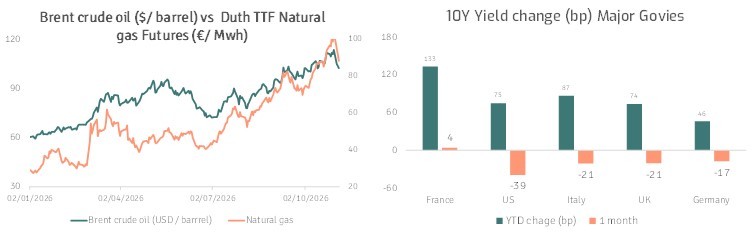
Brent crude oil prices surged c. 19% in October to $113 per barrel, as the market priced in a re-escalation of military tensions in the Middle East. This reignited fears that higher energy costs and their derivatives will weigh on consumer confidence and reduce margins for corporates with insufficient pricing power to mitigate them. Natural gas prices moved in the same direction, with Netherlands TTF natural gas prices surging by 48% over the month to €103/MWh. In addition, freight costs remained elevated, with issuers overall unable to pass on these costs to their customers in the absence of contractual provisions. Overall, rising oil prices and the scarcity of memory chip components are likely to further fuel inflationary concerns in many sectors, including the automotive sector, which uses many electronic components. Accordingly, slumping consumer confidence was evident everywhere from China to the UK and France.
Fed Chairman Kevin Warsh cited a strong US economy and warned of persistent inflation, reinforcing expectations for a rate hike in December. Mr Warsh nevertheless refused to offer explicit guidance on the future pace of policy. Meanwhile, the ECB kept its deposit rate unchanged at 2.5%, while the departure of ECB President Mme Lagarde had no impact on financial markets.
Issuers must pay premiums to access the primary market which remained open for risks
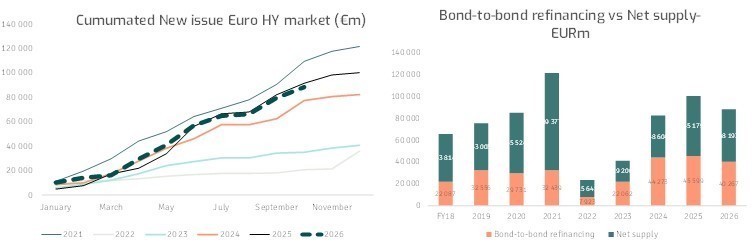
The primary market clearly accelerated at the end of October, bringing EUR High Yield bond issuance to a healthy €8.8bn in October. The vast majority of issuance was related to M&A and LBO financing. This showed that the primary market remains very much open to taking credit risk despite the rising cost of financing.
While interest rates and credit risk are on the rise this year, primary LBO-related EUR High Yield issuance has now reached its highest level in the past five years at €12bn. The same applies to M&A-related issuance, which reached €8.4bn. This lifted net supply to c. €48bn, with the market now well on track to meet our forecast of €50bn in net supply.
With credit risks on the rise, issuers are having to pay a premium relative to market indices or their official ratings. We view issue ratings as increasingly disconnected from the market’s perception of risk. Saur priced new €400m senior unsecured notes due 2031 (NR / BB+) at 7.125%, well above the 5.8% offered on average for EUR BB-rated issues. Italian IT provider and newcomer Bending Spoons also priced new bonds at a large premium to market indices, reflecting its aggressive M&A strategy and high EBITDA adjustments. The company issued new €500m SSNs due 2031 (Ba3 / BB-) at 7.125%, suggesting inappropriate ratings at issuance. Lastly, in the shipping market, SGL priced new €300m FRN SSNs due 2031 at E+6.4% at 97, reflecting our doubts about its ability to generate attractive margins given high freight costs.
Italian generic manufacturer Recordati was the only issuer managing to issue at a decent cost. The €11bn transaction was financed through €6.4bn of new SSNs, alongside €7.2bn of sponsor equity, including €1.5bn of structurally subordinated PIK notes. Following the transaction, the group’s net leverage is expected to reach 5.7x based on reported LTM EBITDA, increasing to a substantial 7.2x when including the PIK notes. Recordati issued the largest-ever FRN through its €2.45bn FRN SSNs due 2033 at E+3.875% (B1 / B+), while its new fixed-rate notes due 2031 and 2033 were placed at 6.35% and 6.875%, respectively.
The bond-to-bond refinancing trend sharply decelerated, with only two transactions printed this month: the new Paprec and Saur issues. The new Saur €400m senior unsecured blue note, 7.125% due 2031 (NR / BB+), took out the old 0.75% SLB due 2028. While the new Paprec 6% SSNs due 2031 (NR / BB) were upsized to €550m from €425m, the new notes came 50bp above SR’s 5.5% fair value.
We included a small premium linked to the faster-than-initially-anticipated acceleration of the M&A strategy, which should lead to a management pro forma net leverage ratio of 3.6x vs. 5.9x for SR’s net adjusted leverage. However, we believe that the temporary rise in leverage ratios should be offset by greater geographical diversification of operations, as well as the marked slowdown in its M&A strategy expected next year. The EBITDA margin remains high at 16.4%, and FCF was positive in 1H26, despite the sharp rise in working capital. In addition, efforts will be focused on integrating the two transformative acquisitions announced in 2025.
Strong divergence across sectors remained during the summer
Telecoms and Real Estate names were under pressure for most of October. The Real Estate sector posted a negative total return of -2.4%, while the Telecom sector returned -2.7%, despite Ziggo 3.375% 2030 and Virgin Media 3.25% 2031 rising by 7.3 and 4.7 points, respectively, over the last week of the month.
The Construction sector remained plagued by persistently high interest rates, primarily affecting the primary market. Unsurprisingly, names more resilient to GDP fluctuations were the best performers. These included the Retail, Food & Beverage and Consumer sectors.
The best-performing sector was Oil & Gas (+0.2%). In such difficult times for credit investors, properly assessing fundamental credit prospects is key to putting money to work. While operating disruptions related to the war in the Middle East affected 9M26 results, Viridien (B2 / B+) managed to reduce gross debt and contain re-leveraging to 2.8x at end-September 2026, based on SR numbers. We highlight oil & gas companies' eagerness to increase exploration spending from recent relatively low levels. We forecast Viridien to deleverage in FY27, allowing the company to refinance its relatively costly SSNs.
About the author
Benjamin Sabahi
LinkedInHead of Credit Research - Spread Research
Benjamin has over 25 years of experience in credit research and financial markets. He is Head of Credit Research and Partner at Spread Research, where he leads the High Yield credit research team. He previously held senior credit research positions at Exane and BNP Paribas Fortis.
More news
Explore related insights and analysis