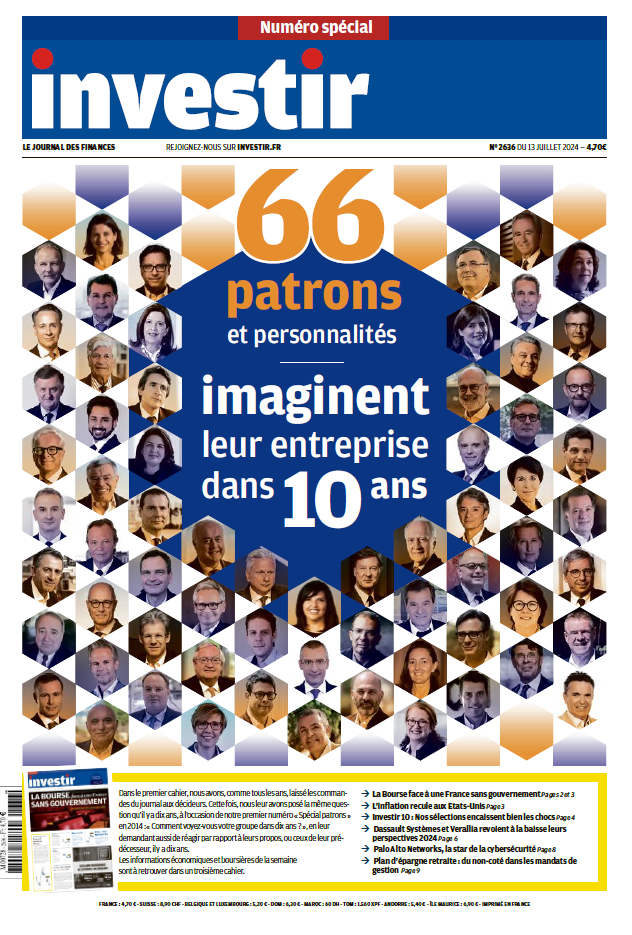
by Carol Sirou, CEO of EthiFinance – Investir, Le journal des finances, issue 2636 of July 13, 2024
From now on, investing in a company means trusting its financial capabilities and strategic commitments, and believing in its trajectory with regard to environmental, social and governance criteria.
At EthiFinance, a European financial and extra-financial rating agency, we have put in place the organization and methodological framework to ensure that ESG rating becomes a genuine tool for forward-looking analysis of these commitments, and provides a substantiated opinion. We see our role as that of a trusted third party for investors.
Since January 1, the CSRD (Corporate Sustainability Responsibility Directive) has provided us with the “fuel” we need to move towards sustainable finance. Companies will be required to disclose their ESG data in accordance with the CSRD framework, which will be applied in stages between now and 2027, starting this year with major groups.
In three to five years’ time, we’ll have audited data, which will be of better quality, more reliable and, above all, more comparable. We’ll also know about companies’ transition plans based on a double materiality vision, i.e. taking into account their risks and opportunities and their impact on their economic, social and environmental environment.
This change was driven by the 2015 Paris Agreement and the 2019 Green Deal. Thanks to this foundation, the European Union is now the global spearhead of the ecological and societal transition.
Today, we see European companies and financial backers ready to embark on this path. They no longer question either the merits or the necessity, but rather the means and the timetable.
The next few years will therefore be crucial for testing the robustness of this extra-financial reporting, for which we are as much obliged as companies, and for which we need to be prepared. While data on environmental issues, such as CO 2 emissions, are fairly measurable and comparable, social criteria are more difficult to assess.
We need to develop statistical tools to understand the issues involved, for example, in the absence of parity or diversity within a company. Controversy analysis – as we practice it – is also a very useful tool. The opinion given on whether or not a company is complying with a stated ESG trajectory, and on the information gathered through extra-financial reporting, is already increasingly taken into account in credit rating.
Another methodological issue concerns the coexistence of two ESG standards: that of the European Reporting Advisory Group (Efrag) in the European Union, and that of the International Sustainability Standards Board (ISSB) outside Europe. Efrag and ISSB have agreed on the principle of interoperability between their standards.
If the world’s major groups were to comply with the European double materiality standard from this year onwards, the two standards would have to be harmonized to facilitate the reporting and comparison exercise essential to their stakeholders.
To bring on board the 50,000 or so European small and medium-sized businesses regulated by the CSRD, the Efrag standard needs to be adapted to the operational realities of smaller companies, and a great deal of education is required. If the political will is there, it’s within our grasp to build relevant reference systems adapted to organizations of all sizes, to help them in their ESG transition.
Beyond these methodological adjustments, we want to work to ensure that non-financial ratings go beyond the simple label of annual reporting to become a solid opinion, based on forward-looking analysis of companies’ commitments.
As a recognized expert in the business for 20 years, our ability to shed light on these debates is indisputable.
The time has come for investors, markets and stakeholders to demonstrate their commitment to sustainable development.
Carol Sirou
CEO of EthiFinance