
Financial needs for the climate transition could reach up to 10 trillion US dollars annually between 2031 and 2050
● EthiFinance, an independent European credit rating agency, ESG rating agency and provider of Second Party Opinions (SPOs), has organized the event “Investment and Financing of the Transition”, where it highlighted that annual financial needs for the climate transition worldwide could reach up to 10 trillion US dollars per year between 2031 and 2050, according to the Climate Policy Initiative.
● The event featured the participation of the Deputy Head of Sustainable Finance at the Directorate General of the Treasury and Financial Policy, Antonio Ortiz, who highlighted that the transition towards more sustainable business models is a real economic opportunity that requires capital mobilization and financial innovation, strengthening the competitiveness and resilience of the business fabric.
● The development of specific labels for transition financial instruments represents a significant step forward to boost the transition finance market, which faces the challenge of expanding financial flows and, at the same time, represents an opportunity given the growing investor interest.
Madrid, 16 March 2026. Annual financial needs for the climate transition worldwide could reach up to 10 trillion US dollars per year between 2031 and 2050, according to the Climate Policy Initiative, as highlighted during the event “Investment and Financing of the Transition”, organized by EthiFinance, an independent European credit rating agency, ESG rating agency and provider of SPOs.
The event, which took place at the Real Casino de Madrid, featured the institutional opening by Antonio Ortiz, Deputy Head of Sustainable Finance at the Directorate General of the Treasury and Financial Policy, who explained that “the transition is not an abstract concept, but a real economic opportunity that requires capital mobilization and financial innovation. It is not a regulatory burden nor an exercise of good intentions, but rather a lever of competitiveness and resilience for the business fabric. Investment in transition contributes to reducing the risks faced by companies and, at the same time, opens new business opportunities, strengthens energy and technological autonomy and acts as a key catalyst for innovation”.
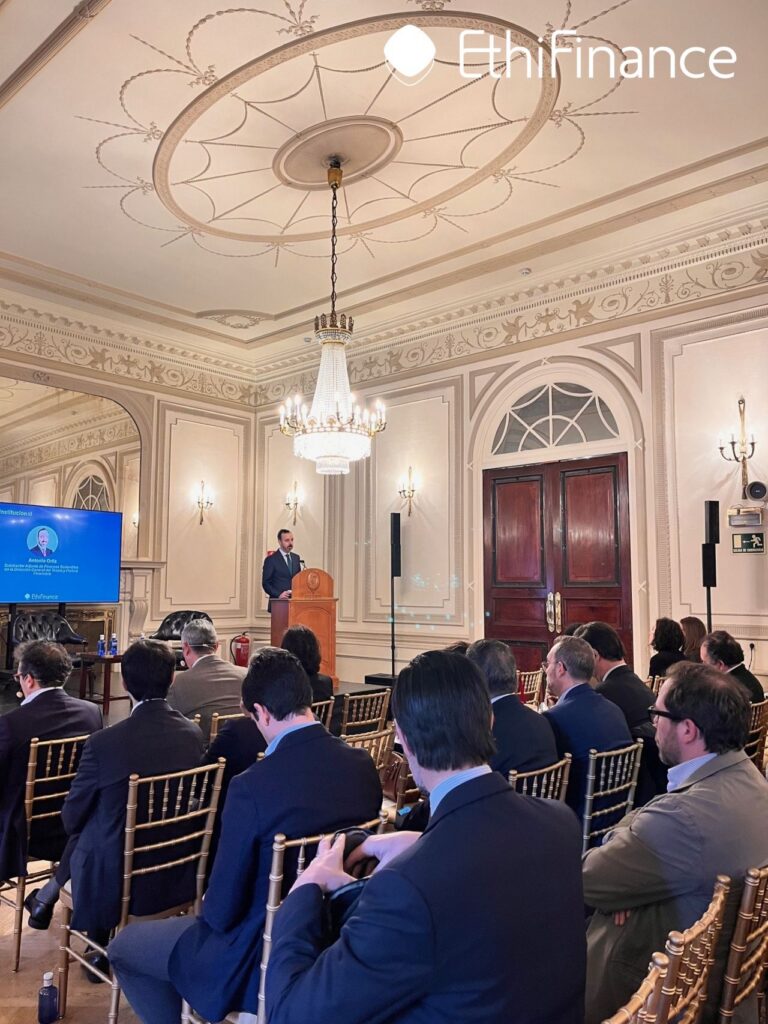
The event was structured in three roundtables that allowed the transition to be addressed from different perspectives, offering a comprehensive vision of the sustainable finance ecosystem and connecting the different links of the value chain: from investor demand to supply from companies and financial institutions.
The first roundtable, moderated by María Cristina Romero, Head of Sustainable Finance Iberia at EthiFinance, brought together Mariola Domenech, Sustainability Director at Acciona Energía, and Jorge Portillo, CEO and Co-Founder of Greemko, with the aim of analyzing how companies are integrating the transition into their business strategy and the importance of measurement and technology in achieving decarbonization targets. María Cristina Romero highlighted that “at EthiFinance we are convinced that this is the right moment to place the climate transition on the agenda of the public and private sectors as a cross-cutting axis for the development of policies and action plans that allow companies to respond with dynamism and innovation to the geopolitical and social challenges of the current context”. During the debate, the speakers agreed on the need to have reliable data that allows companies to measure their progress and communicate transparently their advances in decarbonization. In this regard, Jorge Portillo emphasized that: “a credible transition plan is not a reporting document; it is an operational, financial and governance roadmap to transform the business. For this, the first step is to measure properly and to have the necessary tools to do so”.

The second roundtable, moderated by Pablo Esteban, Deputy Director General of Spainsif and Board Member of Eurosif, included the participation of María Folqué, Lead Marketing Manager Iberia at Allianz Global Investors; Diego Morata, Sustainable Investment Principal at Alantra; and Marc Miralles, Head of Sustainability at Suma Capital. The objective of this debate was to explore the growing investor appetite for transition financial products and the increasing need to understand in depth the transition plans of companies in order to channel capital towards investments truly aligned with the decarbonization of the real economy. Pablo Esteban underlined that “the transition has become a central axis of the European agenda at the level of competitiveness, with the focus placed on strategic sectors such as energy, steel, cement, transport or clean technologies”, also pointing out the importance of strengthening public-private collaboration mechanisms, especially in complex or long-term projects such as infrastructure projects, where it is key to design financial structures that allow the mobilization of private capital and the proper management of risks. For their part, the speakers provided the perspective of asset managers, agreeing on the relevance of having clear roadmaps in order to channel capital towards the transition. María Folqué highlighted that: “without investment in infrastructure there can be no transition”, in line with what was mentioned by Esteban. Likewise, Diego Morata emphasized: “today, analyzing an investment rigorously requires understanding how the transition impacts the business model of the company or asset and translating that impact into financial terms, that is, seeing how it influences CAPEX, costs, sales, growth or risks.
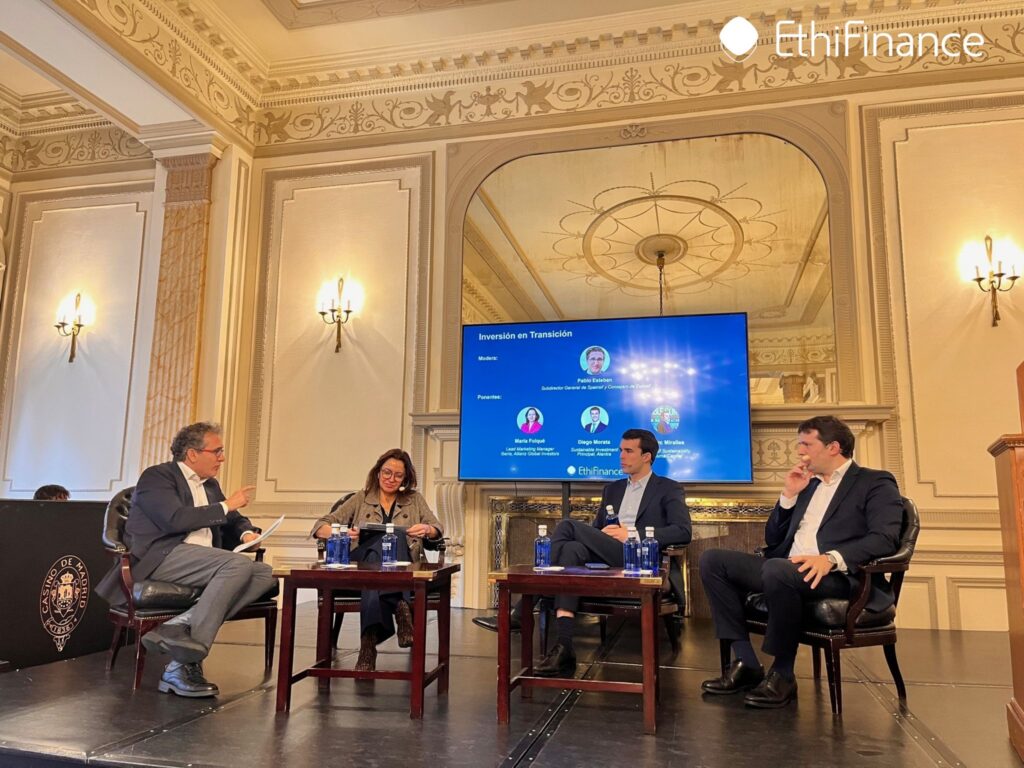
The third roundtable, moderated by Julián Romero, President of the Spanish Observatory of Sustainable Finance (OFISO), brought together Pablo Pérez-Montero, Global Head of Sustainable Finance & ESG Advisory CIB at CaixaBank; Acssana Mendes, Sustainable Banking Iberia Lead – Vice President at Crédit Agricole CIB; Laura Fernández, Head of Sustainable Finance at Telefónica; and Aurora Gracia, Vice President and Sustainability Director at Cunext Group. The objective of this debate was to analyze the challenges of channeling financing towards the sectors that are most difficult to decarbonize and the role of banks in designing financial solutions adapted to the transition. Julián Romero underlined that “one of the major challenges is channeling financing towards the sectors that are most difficult to decarbonize, such as maritime and air transport, mining, steel or cement, where the transition requires significant investments and adapted financial solutions”. During the debate, the speakers addressed both the perspective of the industry, regarding the challenges that companies face in their transformation process, and the role of financial institutions in the development of products and solutions that allow them to accompany their clients on this path towards the transition. For his part, Pérez-Montero highlighted that “the development of innovative financing products and structures is a priority. Transition Finance represents one of the major areas where institutions have placed their strategic focus, playing an essential role in supporting the most emission-intensive sectors”. From the perspective of companies, Fernández highlighted that: “telecommunications networks and digitalization are essential to accelerate the decarbonization of other sectors, therefore it is key to promote investment in these critical infrastructures and thus accelerate the green transition”; for her part Gracia emphasized: “sustainable finance is fundamental to transform industry, at Cunext we have been implementing transformational projects for years, based on decarbonization and business expansion. Our green copper project is a good example of the decarbonization of processes and products, based on the circular economy of copper, guaranteeing a lower environmental.

The event also highlighted that the development of specific labels for the transition represents a significant advance for the development of sustainable investment and financing. At the regulatory level, transition investment could be boosted thanks to the new proposal of SFDR 2.0, which incorporates a new category of transition financial product; and at the national level, with Royal Decree 214/2025, which creates the obligation for certain organizations to calculate their carbon footprint and publish their emission reduction plans. In this same line, transition finance is also being promoted with the recent launch of the Transition Bonds and Loans Principles by ICMA and LMA, respectively. In this regard, Acssana Mendes underlined that: “historically, the absence of a clear framework has been one of the main barriers to redirect financial flows towards transition projects. These new ICMA and LMA guidelines represent a significant advance in terms of transparency and credibility of transition plans, and should contribute to creating a virtuous circle that encourages the development of transition finance”.
However, the promotion of the climate transition requires a regulatory environment that provides greater clarity regarding the concept of transition, that contributes to its interoperability, and that at the same time responds dynamically to the expectations of investors and financiers in a changing and competitive environment, without putting financial stability at risk, as stated in the OFISO Annual Report 2026.
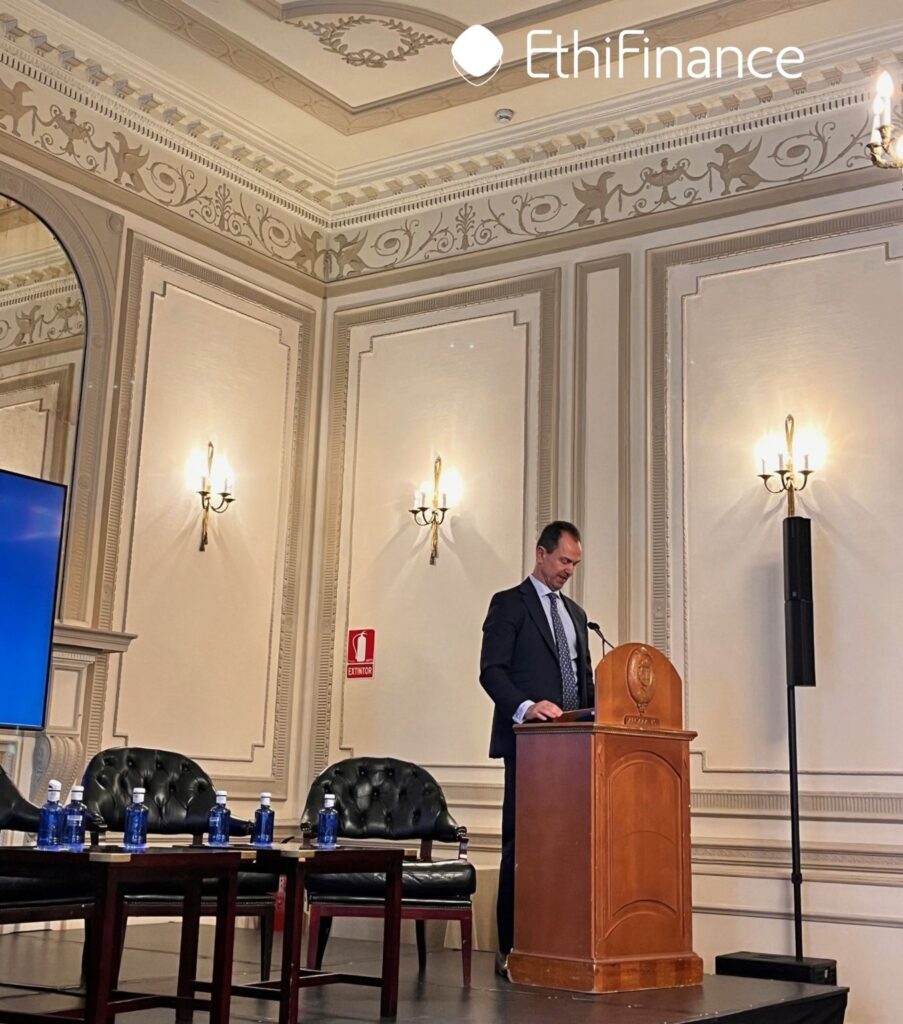
The closing of the event was delivered by Adolfo Estévez, Managing Director Iberia at EthiFinance, who highlighted that “transition finance has ceased to be a minor topic to become one of the central axes of the global agenda. We have observed a very relevant change in mindset regarding the need to address the transformation of sectors that are currently in full transition. We are facing a decisive decade; if we manage to direct flows towards deep transformations and not only towards marginal changes, transition finance can become the engine of a new low-carbon development model, competitive and socially fair”.
About EthiFinance
Headquartered in Paris and with more than 160 employees in Paris, Lyon, Madrid, Granada and Hannover, EthiFinance is a pioneer in ESG Rating, with more than twenty years of experience. The company supports more than 400 clients through its Credit Rating, ESG Rating, research and advisory services, helping them address the challenges of an economic, financial and regulatory environment in constant evolution. Faithful to its values, EthiFinance offers a unique and independent European approach to ESG and credit analysis.
